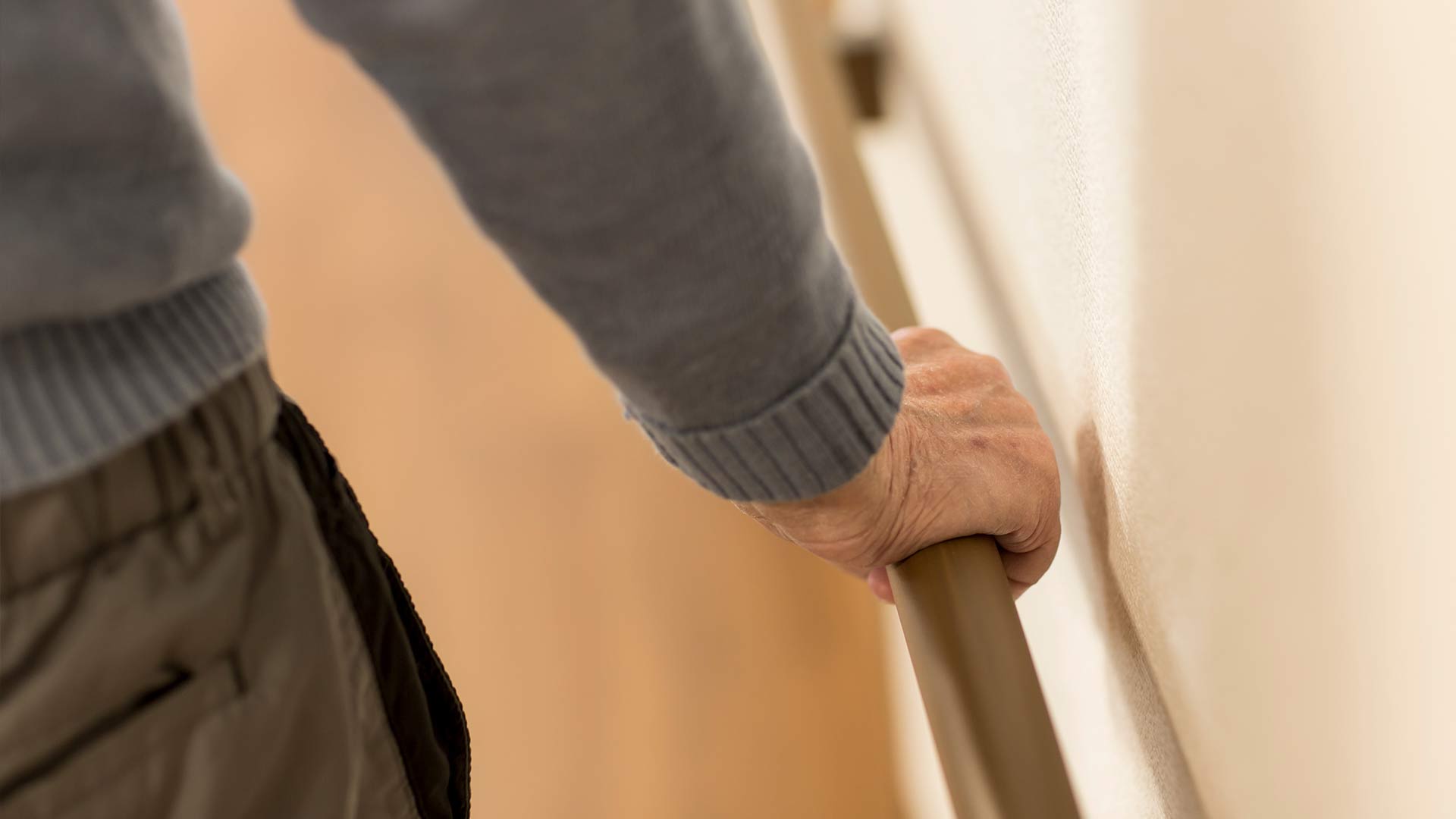
Living safely and independently with Parkinson’s

Motor symptoms such as slowness of movement, tremors and muscle stiffness are not only typical of Parkinson’s disease, the sometimes uncontrolled movements can make living at home extremely difficult. After diagnosis, those affected may therefore rightly ask themselves whether they can stay at home with Parkinson’s at all. The good news is that this is usually possible for a long time. However, it may be necessary to redesign the living spaces to make them suitable for Parkinson’s – whether living room, kitchen, bathroom or bedroom.
So what needs to be considered when adapting the living space? How can mobility within your own four walls be improved? Here you can find out how you can adapt your home so that you can live there safely and independently.
- Safe living space design for Parkinson’s: that’s what matters!
- Parkinson’s-friendly living spaces: fall prevention is particularly important!
- Barrier-free living without tripping hazards
- Living safely and independently with Parkinson’s
- Tips for a safe and well-organized kitchen
- Tips for a safe and non-slip bathroom
- Tips for a Parkinson’s-friendly bedroom
- Financial support for home remodeling
Safe living space design for Parkinson’s: that’s what matters!
People’s own homes are rarely designed to be age-appropriate and barrier-free. However, a diagnosis of Parkinson’s changes many things in the lives of those affected – including the way in which they can live safely and independently for as long as possible in the future. Even though Parkinson’s often does not yet have a major impact on everyday life and living in the early stages, the steadily progressing disease eventually brings patients to the point where something needs to be changed in their home – for their own safety.
A lot can be achieved with simple conversion measures and regular adaptations to the living space. The ultimate goal is to live with Parkinson’s in familiar surroundings for as long as possible. The focus is always on the individual, modifiable needs of the person affected.
Parkinson’s-friendly living spaces: fall prevention is particularly important!
The top priority for Parkinson’s-friendly living spaces and therefore for a safe and independent life is fall prevention. Parkinson’s often causes gait disorders, such as a shuffling, small-step gait, an unstable posture (postural instability) and gait instability. Freezing (sudden freezing of movement) is also one of the symptoms in the later course of the disease. All of these symptoms are associated with an increased risk of falls. It is therefore essential that you remove all fall and trip hazards in your home and install fixtures to hold on to in important places.
Avoiding falls is probably the most important measure for a safe and independent life with Parkinson’s disease. This is because it is usually falls and the associated bone fractures that take away the independence of those affected within their own four walls. You should therefore make all your living spaces safe and barrier-free. The three most important measures for the first step are
- Remove tripping hazards: Typical tripping hazards that should definitely be removed are wavy or slippery carpets or rugs, electrical cables lying around, any unevenness in the floor and uneven transitions to the balcony or terrace. To secure carpets, use non-slip underlays or wear appropriate non-slip socks and shoes. You should avoid uneven floors or height differences (steps) by installing special barrier-free transitions such as ramps.
- Climbing stairs and steps safely: Stepless living spaces and an elevator to reach the apartment are ideal for Parkinson’s patients. Otherwise, handrails on both steps or a stairlift should ensure greater safety. Uneven steps or smooth stairs should also be repaired or fitted with non-slip surfaces to prevent tripping.
- Install lighting: Good lighting in all living areas is essential to avoid the risk of falling. Install lamps so that they illuminate the hallway and the paths from one room to another well. This will prevent you from tripping at night, e.g. on the way to the toilet or when you want to open the front door in the evening. Make sure that you can easily reach the light switches and that the switches are easy to operate. Ideally, you should have motion detectors installed.
Barrier-free living without tripping hazards
Being able to live independently at home for a long time – barrier-free living spaces that are as free of obstacles and tripping hazards as possible help with this. The most important areas are the kitchen, bathroom and entrances. When redesigning your living space, you should pay attention to other things to ensure good mobility in addition to removing tripping hazards, safe stairs and installing good light sources:
- Widen narrow doors so that you can reach all rooms with walking aids, a rollator or wheelchair if necessary. Leaf and sliding doors are not so suitable, but swing doors are, especially in combination with a door drive. The width of the doors should be at least 80 centimeters (cm).
- Replace conventional door handles with special handle sets that can be easily operated with the elbow or back of the hand.
- Remove any bulky furniture that restricts your mobility, because freedom of movement comes first. Sharp corners and edges on furniture are also unfavorable, as they can lead to injuries if you bump into them.
- Attach grab handles in important places.
- Make sure there are enough stable seating options and standing aids in your living space.
- Provide sufficient space for movement, e.g. in the bathroom, hallway and kitchen. It should be at least 120 cm × 120 cm and, if it is to be wheelchair accessible, at least 150 cm × 150 cm.
Good to know: Contact either a medical supply store or an advice center or friends and acquaintances who have a knack for easier conversion measures for advice and for carrying out the measures.
Living independently with Parkinson’s: 5 important pillars
In order to be able to manage your everyday life with all the challenges that Parkinson’s brings with it as comfortably, safely and independently as possible, you should make use of necessary services such as personal assistance, medical care, home adaptations and psychotherapeutic support – depending on your individual situation:
- Personal assistance: This makes everyday life easier and provides help with everyday tasks, such as dressing and undressing and personal hygiene, in order to maintain independence.
- Medical care: To ensure that you take your medication regularly, there is the option of medical care at home.
- Adaptation of living space: To ensure safety in your own four walls and to prevent falls, living spaces must be redesigned to be suitable for Parkinson’s patients.
- Psychological help: Living with Parkinson’s can be very stressful. Psychotherapeutic support is recommended to deal with worries, anxiety or depression.
- Physiotherapy: You should regularly practise exercises at home to improve your mobility and reduce motor symptoms.
Individual needs and the associated adaptations to living spaces will continue to change as the illness progresses. New challenges require new solutions in order to cope with everyday life in the best possible way and improve quality of life. Perhaps it makes sense for you to think about moving into a barrier-free apartment after being diagnosed with Parkinson’s? Especially at the beginning of the disease, few to no restrictions are to be expected and a change of residence can be easily managed.
Living safely and independently with Parkinson’s
The most important measures for safe (barrier-free) room design, such as removing tripping hazards, carpets and cables and installing good lighting, are familiar from the previous sections. Depending on the severity of the symptoms and the stage of Parkinson’s disease, individual needs may change. Below we have put together a clear list of general tips for redesigning living spaces:
- Ensure mobility and space: Provide space so that windows, doors, cupboards and other furniture are easily accessible. Cupboards with sliding doors are practical and easy to handle. Install handles and railings on walls, doors and staircases.
- Attach raising aids: You can raise sitting and lying surfaces to make it easier to stand up. To do this, attach so-called furniture leg extensions under your furniture. Floor/ceiling bars with handles in front of seating furniture, special stand-up chairs or an electric, height-adjustable stand-up bed also make it easier to stand up without assistance.
- Reduce the risk of injury: Your furniture should be stable and tip-proof so that you can safely support yourself on the furniture. You should also provide sharp edges on tables and cupboards with edge protection. Also mark the steps with colored lines on the front edge.
Tip: An alarm (emergency call button) on a wristband that is directly connected to an emergency call center gives you a feeling of security and increases your independence in your own four walls.
Other helpful tips for the living area
- Minimize the risk of freezing: The risk of freezing – the sudden freezing of movement with an increased risk of falling – often occurs when walking through a door. You can minimize the risk of freezing by providing door thresholds with high-contrast transitions (coloured adhesive tapes). Visual barriers can prevent blockages and make your everyday life easier.
- Regulate body temperature: Well-air-conditioned rooms are helpful for Parkinson’s patients, who often have problems regulating their body temperature.
- perform movement exercises: If you have enough space in your own home, a dedicated therapy room would be ideal for regularly practicing the exercises from physiotherapy.
- Select seating furniture according to your own needs: A straight backrest that provides good support for the lower back is considered ideal for seating furniture, as is a high seat and armrests. Adjust the height, depth and width to your body measurements. Chairs and armchairs with upholstery that is too soft or too low are not suitable.
- Choose suitable materials for furniture: Due to the risk of injury, furniture made of glass, e.g. glass tables, should be replaced. You should also choose seating furniture with fabric covers, as you sweat more quickly on plastic chairs or cushions made of synthetic materials, which can irritate the skin.
Recommendations for difficult off-phases
In the so-called off-phases, when the effect of the Parkinson’s medication wears off and the movement disorders restrict general activity to a greater extent, good organization is important:
- If possible, place seating or your bed near a window so that you can look outside even during periods of discomfort.
- Storage surfaces and bedside tables should be within easy reach of the bed or seating furniture. Place all important items that you may need during the off phase there, e.g.: a telephone (with hands-free function), remote controls, a reading lamp, books and newspapers, glasses, radio, medication, drinks and snacks, tissues.
Tips for a safe and well-organized kitchen
How should your kitchen be designed and organized so that you can cope well with Parkinson’s? It is important that all the things you need for preparing food or drinks are within easy reach:
- Install wall units or shelves at a suitable height so that you can reach everything easily and also see inside.
- Provide a seat or workstation in your kitchen where you can do kitchen work.
- Organize special cutlery (e.g. slightly curved cutlery with reinforced handles) and tableware (e.g. mugs and cups with large handles, plates with higher edges) so that you can enjoy your meals more easily. There are also special openers that make it easier to open screw caps and cans.
Tips for a safe and non-slip bathroom
In the bathroom, the motto is: Be careful, danger of slipping! Most accidents actually happen in the bathroom. This is due to wet and slippery tiled floors, which pose a particular risk if you have difficulty walking. So redesign your bathroom to minimize the risk of falling, make personal hygiene easier and provide barrier-free access:
- Lay non-slip tiles in the bathroom (anti-slip coating) or provide non-slip underlays or bath mats to prevent slipping and falling.
- Have a level-access shower with wide access installed in the barrier-free bathroom and equip the shower with a shower stool or folding seat, grab rails and non-slip rubber mats.
- For a bathtub with a very high rim, install access aids such as a bathtub lift. Handrails around the bathtub also provide safety.
- Have the washbasin and other bathroom furniture lowered if you have problems standing for long periods and prefer to sit down in the bathroom.
- Install grab rails or armrests on the toilet to make it easier for you to sit down and stand up. A toilet seat raiser is another useful aid.
- Also look for storage surfaces that you can easily reach and ergonomic fittings.
- Use a mirror that you can tilt. You can look into such a tilting mirror while standing or sitting.
Tips for a Parkinson’s-friendly bedroom
As a rule, the bedroom is not only used for sleeping, but is usually also the dressing room. The room therefore also needs more space to make it easier to get in and out of bed and to get dressed and undressed. Pay attention to the following things when redesigning the bedroom:
- Install sufficient grab rails in important places in the bedroom and dressing room and provide support. A sturdy ceiling hook with a high handle can make it much easier to sit up in bed.
- Mount the light switch within easy reach next to the bed and place a lamp directly next to you on your bedside table.
- Adjust the bed height to suit your needs. Higher settings make it easier to get up and lie down. Special bed frame raisers are available to adjust the bed height. Electrically adjustable slatted frames that make it easier to get up are also helpful.
- Choose a good, firm mattress to sleep on, which also makes it easier to sit up and get out of bed.
Financial support for home remodeling
If a Parkinson’s-related redesign of your living space becomes necessary, you can apply for financial support from your care insurance provider. The prerequisite for this is a recognized care level, from care level 1. Grants, subsidies or low-interest loans are also offered by the individual federal states in Germany in addition to the care insurance fund. Subsidies are available for measures to improve the living environment, such as home modifications, which enable people with Parkinson’s to live independently and thus delay admission to a nursing home.
At least one of the three criteria must be fulfilled for the measures:
- Remodeling enables home care.
- Conversions make home care easier and reduce the burden on patients and care staff.
- Conversion measures enable independent living (with Parkinson’s).
It is best to find out from your care insurance fund to what extent the costs are subsidized.